

Oxygen Rx Professional Treatment
Here’s how oxygen supports the skin, based on published dermatology research:
(see References at bottom of page)

Energy & Microcirculation
Mitochondria in living keratinocytes use oxygen to produce ATP, the energy that powers skin cell turnover, barrier repair, and healthy microcirculation. Topical oxygen has been shown to reach the full living epidermis (~100 µm depth), which is where these processes take place [2].

Supports Collagen Structure
Oxygen is required for proline hydroxylation, the step that stabilizes newly formed collagen into strong, organized fibers. It's a well-established, oxygen-dependent part of skin-repair biology.

Antimicrobial & Calming
C. acnes is an anaerobe and cannot survive in oxygen-rich environments. A published clinical trial showed a 56% reduction in inflammatory acne lesions over 6 weeks [1].
Energy & Microcirculation
Mitochondria in living keratinocytes use oxygen to produce ATP, the energy that powers skin cell turnover, barrier repair, and healthy microcirculation. Topical oxygen has been shown to reach the full living epidermis (~100 µm depth), which is where these processes take place [2].
Supports Collagen Structure
Oxygen is required for proline hydroxylation, the step that stabilizes newly formed collagen into strong, organized fibers. It's a well-established, oxygen-dependent part of skin-repair biology.
Antimicrobial & Calming
C. acnes is an anaerobe and cannot survive in oxygen-rich environments. A published clinical trial showed a 56% reduction in inflammatory acne lesions over 6 weeks [1].
Time-Released Oxygen on the Skin
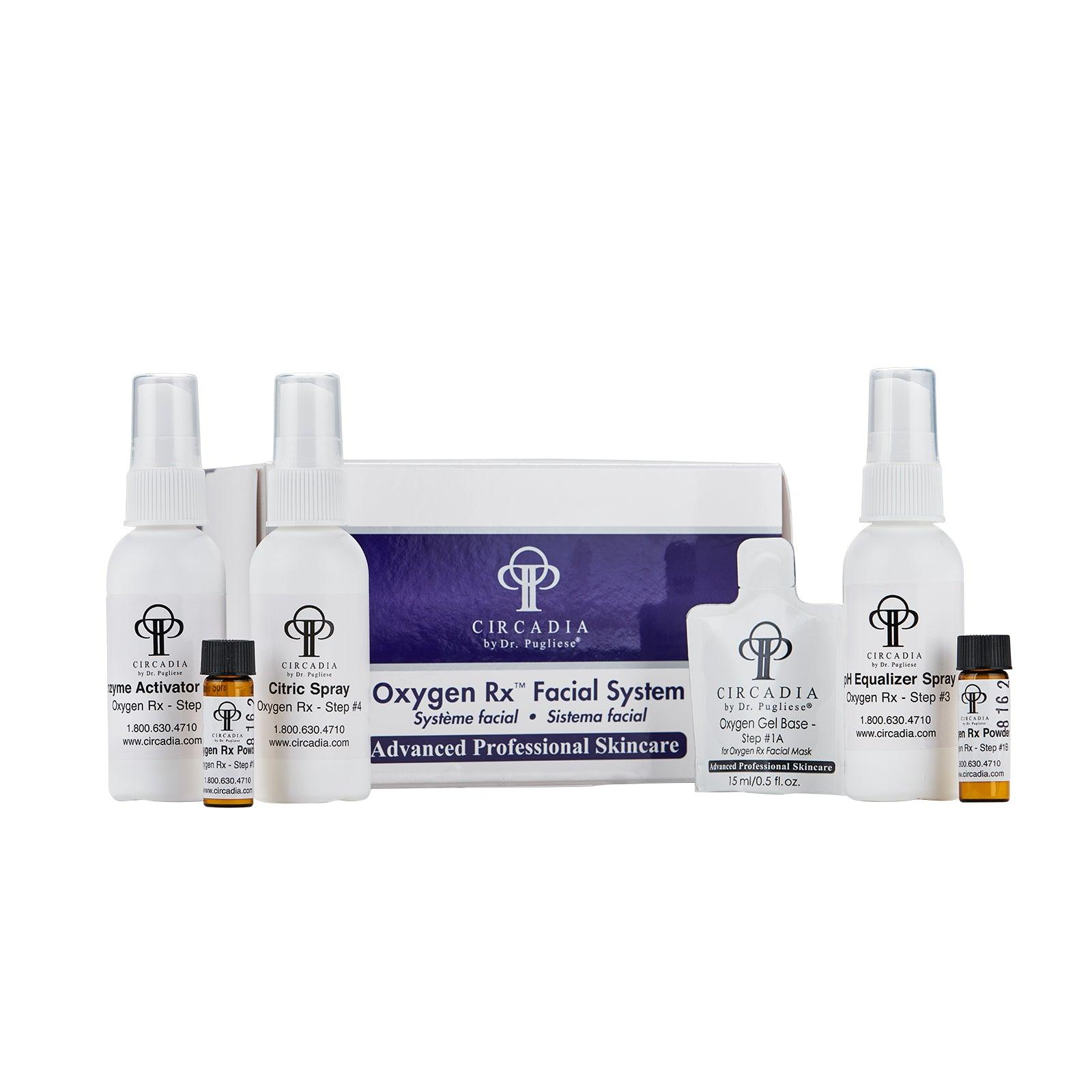
Oxygen Rx is a two-part professional system built around a controlled biochemical reaction. When the Oxygen Rx Powder is mixed with the water-based Gel Base, water hydrates magnesium peroxide and gradually releases hydrogen peroxide.
The Enzyme Activator Spray then supplies catalase, which converts the peroxide into water and molecular oxygen directly at the skin surface. A pH Equalizer stops the enzyme activity, and a Citric Acid mist returns surface pH to normal.
The reaction is timed, controlled, and neutralized. Every step is professional-grade and delivers a dose of oxygen the skin can use, exactly where it is needed. This isn't a bubbly hyperbaric oxygen facial or an oxygen diffusion system. It's time-released oxygen generated in the skin through a controlled reaction.
Surface-Targeted Oxygen
Oxygen Rx works at the surface — the follicular opening, the stratum corneum, and down into the viable cells of the epidermis. That's where topical oxygen influences keratinocyte metabolism and the microbial environment inside the follicle.

Six Ways to Utilize Oxygen Rx in the Treatment Room

Acne and Congestion
C. acnes is an obligate anaerobe. It thrives in the low-oxygen environment of a clogged follicle and cannot survive when that environment is oxygenated [3]. Oxygen Rx generates molecular oxygen directly at the follicular opening, disrupting the conditions that support bacterial overgrowth and the inflammatory cascade around active breakouts. That same oxygen-rich shift works against the sebum-fed, anaerobic conditions congestion depends on — without aggressive extraction.
Clinical use: Incorporate into acne protocols as a treatment-room decongestant and antimicrobial step. Effective on inflammatory acne, comedonal acne, and congestion-prone skin.

Redness and Reactive Skin
Reactive skin flares when the surface environment is inflamed and destabilized. Oxygen Rx calms it without acids, heat, or mechanical exfoliation — it supports a cleaner microbial environment and a lower inflammatory load at the surface, then lets the barrier settle. That makes it an option for reactive protocols where active ingredients and physical exfoliation are off the table.
Clinical use: Reactive skin, rosacea-prone skin, post-inflammatory redness, and any protocol requiring vascular calming without barrier disruption.

Hyperpigmentation Support
Pigment starts in the basal layer. Keratinocytes carry melanin upward as they migrate through the epidermis, and surface pigment clears once those cells complete a normal turnover cycle. That cycle runs on cellular energy. Oxygen Rx raises local oxygen availability, which fuels the metabolism renewal depends on and improves microcirculation and nutrient delivery to the epidermis.
Clinical use: For pigmentation, amplify results by deploying Oxygen Rx before targeted brightening actives like vitamin C, tyrosinase inhibitors, and retinoids. Oxygen Rx doesn't replace pigment-targeting actives. It supports the epidermal environment those actives depend on.

Pre-Procedure Preparation
Perform Oxygen Rx one to two weeks before laser, microneedling, or advanced resurfacing. This lowers baseline inflammation and controls the follicular microbial load. The procedure then starts from a cleaner, calmer baseline for a more predictable response and a shorter recovery window.
Clinical use: Pre-treatment protocol for ablative and non-ablative procedures. Position as a paid prep visit that measurably improves outcomes.

Post-Procedure Recovery
When post-procedure skin is compromised, it can colonize easily with opportunistic organisms and stay inflamed longer. Oxygen Rx creates a controlled surface environment that supports the skin's natural recovery without added actives such as stimulating heat or acids. It calms post-procedure skin so it appears less flushed. Suggested use: 2 weeks post-procedure.
Clinical use:
- Post non-ablative laser
- Post-microneedling
- Post-peel recovery protocols
- Safe on compromised barrier

Pre-Procedure Anti-Aging
Aging skin slows down. Cell turnover and barrier repair decline, resulting in skin that appears duller and less firm. These processes run on ATP, fueled by oxygen [2].
Chronically stressed, sun-damaged, and environmentally taxed skin is often oxygen-depleted at the surface. Oxygen Rx restores surface and upper-epidermal oxygen, giving the skin a healthier baseline and a more receptive foundation for the anti-aging actives you apply next.
Clinical use: Amplify anti-aging and rejuvenating protocols prior to use of peptides, retinoids, and vitamin C.
Pair with the Firming Peptide Mask for an inside-out oxygenating approach — this Firming Peptide treatment drives oxygen from within, while Oxygen Rx works from the surface.
Built for Every Treatment Room
Circadia builds every professional formula for licensed skincare professionals — no one else. Oxygen Rx is never sold through retail channels or direct to consumers. We develop, test, and manufacture every formula in-house, to the standard professionals expect from a treatment built for measurable, repeatable clinical results.
Oxygen Rx at a Glance
- Controlled-release oxygen generated at the skin surface and inside the follicle through a magnesium peroxide and catalase reaction
- Calms the inflammatory and microbial drivers of visible redness — no acids, heat, or exfoliation
- Creates an oxygen-rich environment hostile to C. acnes and other anaerobic organisms
- Oxygenates the follicle to disrupt the anaerobic environment behind congestion without aggressive extraction
- A timed four-step protocol: activate, target, neutralize, pH-restore
- 12 professional treatments per box
- Suitable across acne, brightening, anti-aging, sensitivity, pre-procedure, and post-procedure protocols
- Paraben-free, SLS-free, fragrance-free
- Professional use only

Reference:
The mechanisms and clinical outcomes referenced above are supported by peer-reviewed research on topical oxygen and enzymatic hydrogen peroxide systems in dermatology.
[1] Muizzuddin N, Marenus KD, Maes DH. Enzymatically generated hydrogen peroxide reduces the number of acne lesions in acne vulgaris. Journal of Cosmetic Science. 2013;64(1):1–8. A clinical trial of an enzymatic hydrogen peroxide system for acne demonstrating a 68% reduction in inflammation and 61% reduction in lesion size within four days, and a 56% reduction in inflamed lesions over six weeks.
[2] Stücker M, Struk A, Altmeyer P, Herde M, Baumgärtl H, Lübbers DW. The cutaneous uptake of atmospheric oxygen contributes significantly to the oxygen supply of human dermis and epidermis. Journal of Physiology. 2002;538(3):985–994. Foundational physiology paper establishing that atmospheric oxygen diffuses into the skin to a depth of approximately 100 µm, covering the full living epidermis and papillary dermis, and that under normal conditions the upper skin is substantially supplied by direct atmospheric uptake.
[3] Hernandez P, Sager B, Fa A, Liang T, Lozano C, Khazzam M. Bactericidal efficacy of hydrogen peroxide on C. acnes. Bone & Joint Research. 2019;8(1):3–10. Demonstrates that topical 3% hydrogen peroxide eradicates C. acnes within five minutes of application, supporting its use as a non-antibiotic antimicrobial with no risk of bacterial resistance.




Circadia: Science & Nature in Perfect Rhythm
Professional grade skin care treatments and products for estheticians – developed around the body’s natural circadian rhythm to deliver proven results.